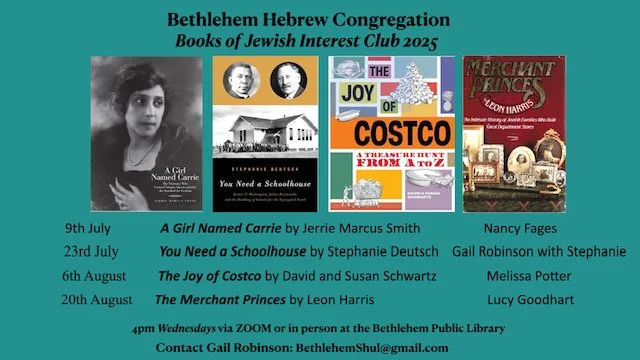

A Girl Named Carrie by Jerrie Marcus Smith, Nancy Fages, discussion leader
Jerrie Marcus Smith remembers her great aunt Carrie as a humorless woman who always wore black and who, Jerrie says, “scared me to death.” Only as an adult did Jerrie grasp the impact of Carrie Marcus Neiman. Along with her brother, Herbert Marcus Sr., and her husband A.L. Neiman, Carrie co-founded in 1907 the famed Neiman Marcus department store in Dallas, Texas.
Carrie played an integral role in the store’s success, despite having three strikes against her: she was a woman, she was Jewish, and (after her husband’s illicit relationship with a second-floor saleswoman) she was divorced. Yet with impeccable taste and exemplary manners, she traveled as a buyer to New York in the 1920s (without a man!) and, as Jerrie says, “was nobody’s pushover.”
Carrie was self-taught and never attended college. Her only pregnancy ended in miscarriage; she worked at Neiman Marcus until her death at age 66. Yet through memories shared by her father, the late Neiman Marcus legend Stanley Marcus, as well as through spellbinding interviews with long retired salespeople, Jerrie has felt inextricably tied to Carrie. Each recollection of Aunt Carrie, each remembrance, each detail melted away Jerrie’s childhood fear of the stern woman in black, leaving in its place a colorful portrait of a person to be admired, to be loved and—perhaps most of all—to be shared.

You Need a Schoolhouse by Stephanie Deutsch, Gail Robinson and Stephanie Deutsch, discussion leaders
Booker T. Washington, the founder of Tuskegee Institute, and Julius Rosenwald, the president of Sears, Roebuck, and Company, first met in 1911 at a Chicago luncheon. By charting the lives of these two men both before and after the meeting, Stephanie Deutsch offers a fascinating glimpse into the partnership that would bring thousands of modern schoolhouses to African American communities in the rural South in the era leading up to the civil rights movement. Trim and vital at just shy of fifty, Rosenwald was the extraordinarily rich chairman of one of the nation’s largest businesses, interested in using his fortune to do good not just in his own Jewish community but also to promote the well-being of African Americans.
Washington, though widely admired, had weathered severe crises both public and private in his fifty-six years. He had dined with President Theodore Roosevelt and drunk tea with Queen Victoria, but he had also been assaulted on a street in New York City. He had suffered personal heartbreak, years of overwork, and the discouraging knowledge that, despite his optimism and considerable success, conditions for African Americans were not improving as he had assumed they would. From within his own community, Washington faced the bitter charge of accommodationism that haunts his legacy to this day. Despite their differences, the two men would work together well and their collaboration would lead to the building of five thousand schoolhouses. By the time segregation ended, the “Rosenwald Schools” that sprang from this unlikely partnership were educating one third of the South’s African American children. These schoolhouses represent a significant step in the ongoing endeavor to bring high quality education to every child in the United States—an ideal that remains to be realized even today.


The Joy of Costco by David and Susan Schwartz, Melissa Potter, discussion leader
Join David & Susan Schwartz on a whirlwind tour of Costco warehouses around the globe. They are two of Costco's biggest fans, yet live in one of NYC's smallest apartments. Since 2016, they have been to over 250 of Costco's 850+ warehouses, plus gotten behind-the-scenes looks at depots, packaging facilities, vendors, meatpacking plants, and even a pre-opening party.
Travelling over 240,000 miles, they have visited at least one warehouse in 47 US states and 13 other countries, including Australia, Canada, China, France, Iceland, Japan, Mexico, New Zealand, Spain, Sweden, South Korea, Taiwan, and the UK. They celebrated the launch of this book with a Yonkers to Yorba Linda Costco Road Trip, stopping to visit their favorite retailer along the way.
Topics are covered in a whimsical A to Z format, using Q&A to cover topics ranging from Cashews and Chicken to Hot Dogs and Hawaii, targeted to delight the more than 128 million Costco members and over 300,000 dedicated Costco employees. There is a Prologue that describes how the authors came to write the book, and an introduction that provides a brief narrative history of Costco and its predecessor companies..
The Merchant Princes by Leon Harris, Lucy Goodhart, discussion leader
Focusing on one city and family per chapter, Harris reveals the fascinating stories of America's great Jewish storekeeping families--the Rosenwalds of Chicago, Riches of Atlanta, Marcuses of Dallas, and Goldsmiths of Memphis, among others--telling how they progressed from ordinary peddlers to the creators of sumptuous retail emporiums. This description may be from another edition of this product.

Past Books of Jewish Interest Seasons
We have saved our past series logs for your knowledge base. Meetings are open to anyone and everyone interested in participating in a reading group. The actual dates for each book will depend on volunteer and Author availability. Please contact us if you want to volunteer or have questions.